HIFIMAN vs PHILIPS Headphones: Which Brand Fits You?
As an Amazon Associate we earn from qualifying purchases. Links on this page are affiliate links.
You are comparing HIFIMAN vs PHILIPS headphones to find the right fit for your listening habits. Both brands offer wired, over-ear studio models designed for comfort and clear stereo sound. They share a common goal of delivering accurate audio for focused listening sessions. The main difference lies in their driver technology and acoustic design. HIFIMAN uses planar magnetic drivers with an open-back design, while Philips relies on 40mm dynamic drivers in a closed, over-ear build. Your choice depends on whether you prioritize soundstage width or passive noise isolation.
Key differences
| Aspect | HIFIMAN Open-Back Planar Magnetic Headphones | Philips Over-Ear Studio Wired Headphones |
|---|---|---|
| Driver Type | Planar Magnetic | 40mm Dynamic |
| Acoustic Design | Open-Back | Closed (Passive Noise Isolation) |
| Weight | 13.8 ounces | 8.8 ounces |
| Cable Length | Not listed | 2 meters |
| Dimensions | 12 x 10.5 x 7.09 inches | Not listed |
Which one should you choose?
Choose HIFIMAN Open-Back Planar Magnetic Headphones if
- You want a wide, natural soundstage typical of open-back planar magnetic drivers.
- You prefer a lightweight build for extended studio monitoring sessions.
- You are listening in a quiet environment where sound leakage is not a concern.
Choose Philips Over-Ear Studio Wired Headphones if
- You need passive noise isolation to block out background noise.
- You want a lighter, more portable option for on-the-go use.
- You value a fixed 2-meter cable for flexible movement around your workspace.
Verdict: Choose HIFIMAN if you prioritize accurate, low-distortion audio and a spacious soundstage for critical listening in a controlled environment. Pick Philips if you need passive noise isolation, a lighter weight, and a longer cable for versatile use in noisier settings.
HIFIMAN vs Philips Headphones Comparison
Acoustic Design
The HIFIMAN HE400SE uses an open-back planar magnetic design. This configuration allows sound to escape the earcup, creating a wide, natural soundstage that many audiophiles prefer for critical listening. However, this openness means it offers no passive noise isolation. The Philips P2000 is a closed-back model. It relies on physical seals around the earcup to block outside noise. This design provides better passive noise isolation, making it more suitable for noisy environments. You must choose between the expansive sound of the HIFIMAN or the focused isolation of the Philips. Each approach serves different listening priorities and environments.
Driver Technology
HIFIMAN employs planar magnetic drivers with acoustically invisible stealth magnets. These conductive layers cover the diaphragm, significantly lowering distortion compared to conventional dynamic drivers. This technology aims for pure, full-range sonic output with minimal wave diffraction. The Philips P2000 uses standard 40mm dynamic drivers. While the specific distortion metrics are not listed, the 40mm size is a common standard for delivering crisp, clear sound in studio monitoring. The HIFIMAN offers advanced planar technology for reduced distortion, while the Philips provides a reliable dynamic driver setup. You get different engineering approaches to achieving clear audio reproduction.
Weight and Comfort
The HIFIMAN HE400SE weighs 13.8 ounces. It features a newly designed adjustable lightweight headband intended to keep you cool during long sessions. The Philips P2000 is lighter at 8.8 ounces. It includes soft, comfy ear-cup cushions and a cushioned adjustable headband for all-day use. The Philips is nearly five ounces lighter, which may reduce pressure on your head during extended listening. Both models prioritize comfort with adjustable bands. However, the significant weight difference means the Philips may feel less fatiguing over time. You should consider how much weight matters for your personal comfort.
Connectivity Options
Both headphones are wired and include a 3.5mm jack. The HIFIMAN comes with a dual-sided high-performance 3.5mm cable and a 6.35mm adapter for maximum compatibility. The Philips also includes a 1/8 inch jack and a snap-on 1/4 inch adapter. The Philips cable is explicitly stated to be 2 meters long, giving you freedom to move around while connected to laptops or tablets. The HIFIMAN cable length is not specified in the provided data. Both offer standard wired connectivity with adapters for professional equipment. The Philips provides a known cable length for planning your setup.
Sensitivity and Source
The HIFIMAN HE400SE has high sensitivity, making it a perfect match for low-voltage sources. This includes portable hi-res audio players. This spec suggests it can produce loud, clear sound from devices with limited power output. The Philips P2000 data does not list sensitivity or impedance values. Without these specs, it is unclear how well the Philips performs with low-power portable devices compared to the HIFIMAN. The HIFIMAN explicitly targets portable hi-res players, offering a clear advantage for users with such sources. You should check the Philips specs if you plan to use it with small players.
Build Features
The HIFIMAN HE400SE features a newly designed casing to protect drivers from the elements and enhance durability. It focuses on structural protection for the internal components. The Philips P2000 includes 90-degree rotating earcups. This feature allows for easy one-ear DJ monitoring, adding versatility for specific professional uses. The Philips also highlights a lightweight headband for durability. The HIFIMAN emphasizes driver protection, while the Philips offers functional rotation for monitoring tasks. Both designs aim for durability, but the Philips adds a specific mechanical feature for varied listening styles.
Choose Your Ideal HIFIMAN or Philips Headphones
Critical listeners wanting wide soundstage
You need the HIFIMAN HE400SE for its open-back planar magnetic design. This setup creates a natural, wide soundstage by allowing sound to escape the earcup. The stealth magnets reduce wave diffraction, delivering accurate, full-range audio with significantly lower distortion than conventional dynamic drivers. This makes it ideal for focused, critical listening sessions.
Users prioritizing lightweight comfort and portability
The Philips P2000 weighs only 8.8 ounces, making it lighter than the HIFIMAN option. It features soft ear-cup cushions and a cushioned adjustable headband for all-day comfort. The 2-meter cable offers freedom of movement, while the 90-degree rotating earcups allow for easy one-ear monitoring. This design suits those who value lightweight durability and flexibility.
Listeners needing passive noise isolation
If you require isolation from external noise, the Philips P2000 is the better choice. Its over-ear fit ensures excellent passive noise isolation, letting you enjoy music without disturbing others. In contrast, the HIFIMAN HE400SE is open-back, meaning it offers no passive noise isolation. The Philips model keeps sound contained within the earcups for private listening.
Audiophiles seeking low-distortion planar audio
The HIFIMAN HE400SE uses planar magnetic drivers with conductive layers covering nearly the entire diaphragm. This design results in significantly lower distortion than the Philips 40mm dynamic drivers. The acoustically invisible stealth magnets further reduce interference, yielding pure sonic output. If you prioritize technical accuracy and minimal distortion, this planar design offers superior clarity.
The products compared

HIFIMAN Open-Back Planar Magnetic Headphones
Best for: critical listening and studio monitoring
- Form Factor
- Over-Ear Open-Back
- Connectivity
- Wired, 3.5mm, 6.35mm adapter
- Audio Features
- Stereo
- Recommended Use
- Studio
- Driver Type
- Planar Magnetic
- Dimensions
- 12 × 10.5 × 7.09 inches
View on Amazon: HIFIMAN Open-Back Planar Magnetic Headphones Affiliate link
These HIFIMAN HE400SE headphones use planar magnetic drivers for low distortion. The open-back design creates a natural soundstage. They connect via a wired 3.5mm cable with a 6.35mm adapter. The lightweight headband ensures comfort for long sessions. High sensitivity works well with portable players. You get accurate audio for studio monitoring or critical listening.
Pros
- Planar magnetic drivers reduce distortion significantly
- Stealth magnets minimize wave diffraction
- High sensitivity matches low-voltage sources
- Lightweight headband stays cool during use
Cons
- Wired connection limits mobility
- Open-back design leaks sound
- No included carrying case
Good fit if
- You want accurate studio monitoring
- You listen in a quiet room
- You prefer open-back soundstages
Skip if
- You need wireless freedom
- You require noise isolation
- You want a compact travel size
Verdict: HIFIMAN HE400SE Planar Magnetic Headphones deliver precise audio for listeners who prioritize sound quality over convenience. They suit those who listen in controlled environments and value driver technology.
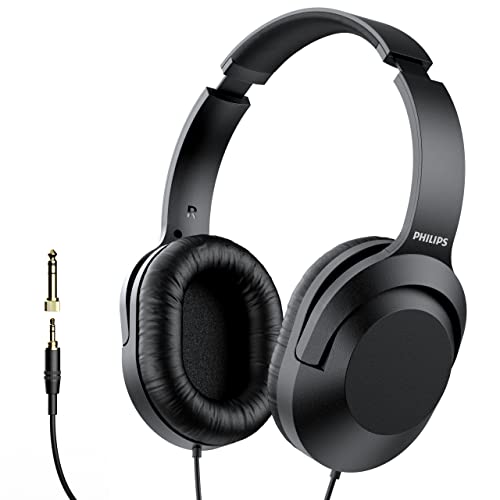
Philips Over-Ear Studio Wired Headphones
Best for: Studio monitoring and podcast recording
- Noise Cancellation
- Passive noise isolation
- Form Factor
- Over-ear
- Connectivity
- 3.5 mm, 6.3 mm (1/4") adapter
- Driver Size
- 40mm
- Audio Features
- Stereo
- Recommended Use
- Studio
View on Amazon: Philips Over-Ear Studio Wired Headphones Affiliate link
The Philips P2000 is a wired over-ear headphone designed for studio monitoring and podcasting. It uses 40mm drivers to deliver stereo sound with passive noise isolation. The 2-meter cable allows for moderate movement, and the 1/8-inch jack includes a 6.3mm adapter for versatility. Weighing 8.8 ounces, it features rotating earcups for one-ear monitoring. This model suits users who need reliable, comfortable wired audio for professional or casual listening.
Pros
- 40mm drivers provide clear stereo audio
- Passive noise isolation for focused listening
- Includes 6.3mm adapter for versatile connectivity
- Rotating earcups enable one-ear monitoring
- 2-meter cable allows flexible movement
Cons
- Lacks active noise cancellation technology
- Wired connection limits wireless freedom
- No built-in microphone for calls
Good fit if
- You need passive isolation for studio work
- You prefer wired reliability over wireless
- You want rotating earcups for monitoring
Skip if
- You require active noise cancellation
- You need wireless Bluetooth connectivity
- You want a built-in microphone
Verdict: The Philips P2000 Over-Ear Wired Headphones fits users who prioritize wired stability and passive isolation for studio or podcast tasks. It is a practical choice for those who do not need wireless features or active noise cancellation.
Specifications side by side
| Spec | HIFIMAN Open-Back Planar Magnetic Headphones | Philips Over-Ear Studio Wired Headphones |
|---|---|---|
| Noise Cancellation | not stated | Passive noise isolation |
| Form Factor | Over-Ear Open-Back | Over-ear |
| Connectivity | Wired, 3.5mm, 6.35mm adapter | 3.5 mm, 6.3 mm (1/4") adapter |
| Driver Size | not stated | 40mm |
| Audio Features | Stereo | Stereo |
| Recommended Use | Studio | Studio |
| Acoustic Design | Open-Back | not stated |
| Driver Type | Planar Magnetic | not stated |
| Color | Silver,Black | Black |
| Dimensions | 12 × 10.5 × 7.09 inches | not stated |
| Weight | 13.8 ounces | 8.8 ounces |
| Model | He400SE | p2000 |
| Size | not stated | One Size |
Frequently asked questions
Which HIFIMAN or Philips headphones are best for studio monitoring?
The HIFIMAN HE400SE is designed for critical listening and studio monitoring. It uses open-back planar magnetic drivers to deliver precise audio. The Philips P2000 is also recommended for studio tasks. It provides wired stability and passive isolation for podcast recording.
Do HIFIMAN and Philips offer wireless headphones in this list?
No. Both the HIFIMAN HE400SE and the Philips P2000 are wired headphones. They do not support Bluetooth or wireless connectivity. You must use a physical cable to connect them to your audio source for both brands.
Which brand offers lighter headphones for long listening sessions?
The Philips P2000 is the lighter option. It weighs 8.8 ounces. The HIFIMAN HE400SE weighs 13.8 ounces. If you prioritize a lighter fit for extended wear, the Philips model is the practical choice based on these specifications.
What is the difference in driver technology between these two?
The HIFIMAN HE400SE features planar magnetic drivers. This technology is known for detailed sound reproduction. The Philips P2000 does not specify its driver type in the provided data. It focuses on general studio monitoring performance without highlighting specific driver mechanics.
Are these headphones open-back or closed-back?
The HIFIMAN HE400SE uses an open-back acoustic design. This allows sound to escape the earcup. The Philips P2000 does not list its acoustic design in the data. You should assume it is not open-back unless specified otherwise for studio isolation.
Which headphones are better for a controlled listening environment?
The HIFIMAN HE400SE suits controlled environments best. Its open-back design requires a quiet space to prevent sound leakage. The Philips P2000 offers passive isolation. This makes it more suitable if you need to block out external noise in your workspace.