TOZO vs PSIER Headphones: Which Brand Fits You?
As an Amazon Associate we earn from qualifying purchases. Links on this page are affiliate links.
You are comparing TOZO vs PSIER headphones for open-ear listening. Both brands offer IPX5 water resistance and up to ten hours of battery life. The main difference lies in their technology and connectivity. TOZO uses clip-on earbuds with Bluetooth 5.4. PSIER relies on bone conduction with Bluetooth 6.0. Each approach suits different activities and comfort preferences.
Key differences
| Aspect | TOZO OpenEarRing Clip-On Earbuds | PSIER Lightweight Bone Conduction Headphones |
|---|---|---|
| Form Factor | Clip-on earbuds | Bone conduction headband |
| Connectivity | Bluetooth 5.4 | Bluetooth 6.0 |
| Total Battery Life | 40 hours with case | 10 hours (no case listed) |
| Audio Technology | OrigX Acoustic Tech | Bone conduction drivers |
| App Features | 32 EQ modes | EQ, AI music, translation |
Which one should you choose?
Choose TOZO OpenEarRing Clip-On Earbuds if
- You prefer lightweight earbuds that sit on your ears rather than a headband.
- You need a charging case to extend your total listening time to 40 hours.
- You want simple touch controls for calls and music without a complex app.
Choose PSIER Lightweight Bone Conduction Headphones if
- You want to keep your ear canals completely open for situational awareness.
- You prioritize the latest Bluetooth 6.0 standard for stable connectivity.
- You are interested in app features like AI music generation or translation.
Verdict: Choose the TOZO OpenEarRing if you want a compact, clip-on design with a charging case for extended travel. Choose the PSIER bone conduction headphones if you prefer a headband style that leaves your ears fully open and want access to advanced app features. Both offer solid durability for outdoor use.
TOZO vs PSIER Headphones Comparison
Form Factor Design
You need to decide how you prefer to wear your audio gear. The TOZO OpenEarRing uses a clip-on design that attaches directly to your ear. Each earbud weighs just 5.1 grams, creating a lightweight experience that avoids pressure on the ear canal. This is ideal if you wear glasses, as the design contours without clashing with frames. In contrast, the PSIER headphones use a bone conduction headband style. They rest on your cheekbones rather than inside or clipping to the ear. Weighing 23 grams total, they feature a flexible memory-titanium frame. This open-ear approach keeps ear canals free for better airflow. You get a secure fit suitable for running, but the form factor is fundamentally different from TOZO's clip-on buds.
Connectivity Standard
Wireless stability and range matter for your daily routine. The TOZO OpenEarRing features Bluetooth 5.4 technology. This chip offers optimized anti-interference and strong signal penetration, fixing common pain points like high latency or disconnections. You get a stable 15-meter connectivity range, which is sufficient for moving around your home or office. The PSIER headphones take a different approach with Bluetooth 6.0. This newer standard promises instant pairing and ultra-stable connectivity with a reliable 33-foot range. It also boasts a 60 ms low latency, which can help with video syncing. While both use Type-C charging, PSIER’s Bluetooth 6.0 spec offers a wider range and lower latency on paper.
Audio Technology
Sound reproduction varies significantly between these two devices. TOZO utilizes its proprietary OrigX Acoustic Tech to deliver Hi-Res Stereo audio. This aims for crystal-clear resolution, capturing vocal inflections and instrumental layers for a vivid listening experience. It is designed for music lovers and movie watchers who want immersive background details. PSIER relies on bone conduction technology with large 13 mm drivers and 90 dB sensitivity. This method delivers sound through the bone, producing rich, balanced audio with crisp highs. It also features an enclosed cavity design that reduces sound leakage by up to 50%. If you prefer traditional stereo separation, TOZO’s approach differs from PSIER’s bone-transmission method.
App and Customization
Personalizing your sound and using smart features depends on the companion apps. The TOZO OpenEarRing works with the TOZO APP, which allows you to customize your EQ. You can choose from 32 different EQ modes to tailor the sound for genres like jazz, blues, or classical music. This gives you direct control over the audio profile. The PSIER headphones support the Boean App, which offers more diverse features. Beyond adjustable EQ settings like Bass Boost, it includes AI Music generation to create original songs. It also provides real-time translation across 91 languages. If you want multilingual communication tools or AI creativity, PSIER’s app provides more functionality than TOZO’s EQ-only focus.
Battery and Charging
Endurance and charging speed are key for all-day use. Both products offer up to 10 hours of playback on a single charge. However, the total system capacity differs. The TOZO OpenEarRing charging case provides an additional 30 hours, bringing the total to 40 hours of playback. It features a digital display on the case to show battery status. The PSIER headphones offer 10 hours of listening at 50% volume, with a massive 200-hour standby time. They use Type-C fast charging, reaching a full charge in about 2 hours. While TOZO offers more total portable power with its case, PSIER’s fast charging and long standby are notable strengths.
Which TOZO or PSIER model fits you
You want stable Bluetooth 5.4 and EQ control
The TOZO OpenEarRing uses Bluetooth 5.4 for stable connections up to 15 meters. You can customize your sound with 32 EQ modes via the app. The clip-on design weighs 5.1 grams per bud. This keeps your ears open while providing Hi-Res stereo audio through OrigX technology. It is ideal if you prefer direct ear contact and precise sound tuning.
You need the latest Bluetooth 6.0 connectivity
The PSIER headphones feature advanced Bluetooth 6.0 for ultra-stable connectivity and a 33-foot range. This offers lower latency and instant pairing. The bone conduction tech delivers sound through your cheekbones. This keeps your ear canals free for better airflow. It is the better choice if you prioritize the newest wireless standard and situational awareness during outdoor activities.
You wear glasses and need zero pressure
TOZO engineered these earbuds specifically for glasses wearers. The clip-on design contours to your ears without clashing with frames. Each bud weighs only 5.1 grams, ensuring zero ear pressure even during all-day wear. The skin-friendly silicone prevents irritation. This makes it the practical choice if you struggle with discomfort from traditional earbuds when wearing eyewear.
The products compared
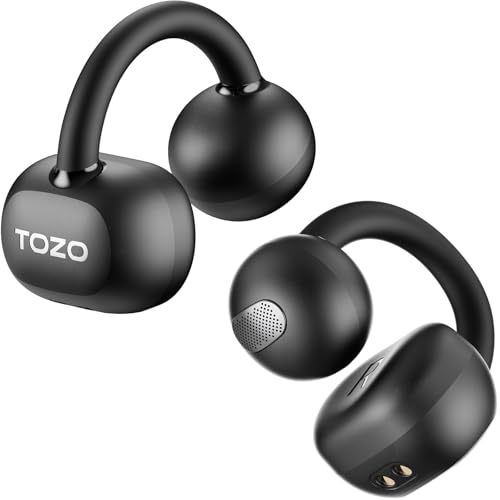
TOZO OpenEarRing Clip-On Earbuds
Best for: glasses wearers seeking open-ear comfort
- Form Factor
- Open-Ear
- Battery Life
- 10 hours (40 hours with case)
- Connectivity
- Bluetooth 5.4, Type-C
- Water Resistance
- IPX5
- Recommended Use
- Workout
- Color
- Black
View on Amazon: TOZO OpenEarRing Clip-On Earbuds Affiliate link
These TOZO OpenEarRing earbuds use a clip-on open-ear design for a secure fit. They feature Bluetooth 5.4 for stable connections and OrigX acoustic technology for stereo sound. You get up to 10 hours of playback per charge, with the case adding 30 more hours. The lightweight 5.1g earbuds are designed to avoid pressure, even for glasses wearers. A digital display on the case shows battery status.
Pros
- Bluetooth 5.4 connectivity for stable pairing
- 40 total hours of battery life with case
- OrigX acoustic technology for stereo resolution
- Lightweight 5.1g clip-on design
- 32 customizable EQ modes via app
Cons
- Open-ear design does not block outside noise
- IPX5 water resistance is not sweat-proof
- No active noise cancellation included
Good fit if
- You wear glasses and need a pressure-free fit
- You want to stay aware of your surroundings
- You need long battery life for travel
Skip if
- You require deep bass isolation
- You need active noise cancellation
- You prefer in-ear silicone tips
Verdict: TOZO OpenEarRing Clip-On Earbuds offer a secure, lightweight fit for glasses wearers who prioritize situational awareness. The 40-hour battery life and Bluetooth 5.4 stability make them a practical option for all-day use.

PSIER Lightweight Bone Conduction Headphones
Best for: Runners and cyclists needing situational awareness
- Form Factor
- Open-ear, bone conduction
- Battery Life
- Up to 10 hours
- Connectivity
- Bluetooth 6.0, Type-C
- Driver Size
- 13 mm
- Water Resistance
- IPX5
- Recommended Use
- Workout, Running, Gym
View on Amazon: PSIER Lightweight Bone Conduction Headphones Affiliate link
The PSIER X12 uses bone conduction to deliver audio through your cheekbones, keeping your ears open to surroundings. It weighs 23g and features Bluetooth 6.0 for stable connectivity. You get up to 10 hours of playback and IPX5 water resistance. This open-ear design suits runners and cyclists who need situational awareness without sacrificing audio clarity.
Pros
- Weighs only 23g for lightweight comfort
- Bluetooth 6.0 with 60 ms low latency
- IPX5 water and sweat resistance
- 10 hours of battery life at 50% volume
Cons
- 10-hour battery life is shorter than the 40-hour competitor
- IPX5 rating is lower than typical IPX7 sports standards
- No wired connection option listed
Good fit if
- You want to stay aware of traffic while running
- You prefer open-ear designs to avoid ear fatigue
- You need lightweight headphones for long outdoor sessions
Skip if
- You require deep, isolated bass response
- You need all-day battery life over 10 hours
- You plan to swim with your headphones
Verdict: The PSIER X12 Bone Conduction Headphones offer a secure, lightweight fit for active users who prioritize safety and comfort over maximum battery life.
Specifications side by side
| Spec | TOZO OpenEarRing Clip-On Earbuds | PSIER Lightweight Bone Conduction Headphones |
|---|---|---|
| Form Factor | Open-Ear | Open-ear, bone conduction |
| Battery Life | 10 hours (40 hours with case) | Up to 10 hours |
| Connectivity | Bluetooth 5.4, Type-C | Bluetooth 6.0, Type-C |
| Driver Size | not stated | 13 mm |
| Water Resistance | IPX5 | IPX5 |
| Recommended Use | Workout | Workout, Running, Gym |
| Microphone | not stated | Microphone |
| Color | Black | Black |
| Dimensions | 3.58 × 3.5 × 1.22 inches | not stated |
| Weight | 1.76 ounces | not stated |
| Size | Large | not stated |
| Model | T13064 | X12 |
Frequently asked questions
Are TOZO OpenEarRing earbuds good for people who wear glasses?
Yes. The TOZO OpenEarRing Clip-On Earbuds are designed for glasses wearers seeking open-ear comfort. Their clip-on design avoids pressure on the ear canal, which often causes discomfort when wearing temple arms. You get a secure fit without interference.
Do PSIER bone conduction headphones work well for running?
Yes. The PSIER Lightweight Bone Conduction Headphones are recommended for running and cycling. This form factor keeps your ears open to traffic and surroundings, enhancing safety during outdoor activities. They provide a secure fit that stays in place while you move.
Which brand offers better situational awareness for outdoor use?
Both brands prioritize situational awareness through open-ear designs. The TOZO OpenEarRing uses clip-on earbuds to let ambient sound in. The PSIER X12 uses bone conduction technology. Both methods allow you to hear your environment clearly while listening to audio.
How much do the TOZO OpenEarRing earbuds weigh?
The TOZO OpenEarRing Clip-On Earbuds weigh 1.76 ounces in total. This large size unit is lightweight for all-day use. The individual earbuds are small enough to remain comfortable during extended listening sessions without causing ear fatigue or strain.
Is Bluetooth 5.4 included with the TOZO model?
Yes. The TOZO OpenEarRing features Bluetooth 5.4 connectivity. This version provides stable connections and reliable performance. You benefit from improved signal stability compared to older Bluetooth standards, ensuring consistent audio playback without frequent dropouts or interference during use.
What is the battery life on the TOZO OpenEarRing?
The TOZO OpenEarRing offers 40 hours of battery life. This duration supports extended listening sessions without frequent recharging. You can rely on this capacity for daily commutes or long workdays, making it a practical option for users who need long endurance.
Does the PSIER X12 have specific color options?
The PSIER Lightweight Bone Conduction Headphones are available in black. This classic color choice suits various personal styles. The model X12 maintains a sleek appearance while delivering bone conduction audio performance for active users who need durable and stylish gear.